
AI SEO Strategy: How to Get Found in the Age of AI Search

Share:
Share:

An AI SEO strategy is a plan for getting your business named and linked when buyers ask Google’s AI Overviews, AI Mode, ChatGPT, Perplexity or Gemini a question instead of scrolling a page of links. Keep doing the SEO basics, because these tools still read the web through crawlers and search indexes. Then add four things. Answer the buyer’s question plainly in the first 150 words of each page. Keep your business facts identical everywhere online. Get other sources to say the same things about you. And check that your robots.txt file and firewall aren’t quietly turning AI crawlers away.
An AI assistant doesn’t hand out ten positions. It writes one answer and cites a handful of sources. If your page can’t be quoted in a sentence or two, and nobody else confirms it, you’re left out, even where you rank well.
Key takeaways
- Classic SEO is still the entry ticket for Google’s AI features.
- AI tools quote passages, not pages. Put the plain answer at the top.
- Keep your business facts identical on every profile.
- Blocking a search crawler like OAI-SearchBot keeps you out of ChatGPT search answers.
- Measure with a monthly prompt list and GA4 referrals, and expect both to undercount.
In this guide
How search changed
The results list still exists. More and more often, though, a written answer sits above it, or the buyer skipped Google and asked a chatbot.
Google runs two AI features in Search. AI Overviews are the summaries at the top of some results pages. AI Mode is a separate, conversational search for longer questions. Per Google Search Central, “AI features and your website” (last updated December 10, 2025, checked October 27, 2026), both can use query fan-out: the system runs several related searches across subtopics and pulls supporting links from what it finds. Your page can be cited for a question nobody typed word for word.
Outside Google, ChatGPT and Perplexity send their own crawlers, then write answers with links. You’ll also hear this work called AEO, or GEO, short for generative engine optimization. The labels change. The question doesn’t: when a buyer asks a machine who to hire, does your name come up?
What still matters from classic SEO
Most of it. Google’s AI features page says there are no additional requirements or special optimizations needed to appear in AI Overviews or AI Mode. A page has to be indexed and eligible to show with a snippet. Google also says you don’t need AI text files or special schema.
So if your site has crawl problems or thin pages, fix that first. An AI can’t quote a page it never read. A website scan will tell you whether the basics are in place. What changed is what wins once you’re eligible:
| Classic SEO (still required) | What’s new for AI search | |
|---|---|---|
| Access | Googlebot can crawl and index the page | AI search crawlers are allowed in robots.txt and not blocked by your firewall or CDN |
| Content | Pages match search intent and target a keyword | The answer sits in the first 150 words, in a sentence or two an AI can lift |
| Authority | Backlinks from relevant sites | Other sources state the same facts about you, links or not |
| Business facts | Accurate Google Business Profile | Identical name, address, phone, services and claims on every profile and directory |
| Measurement | Rankings and organic clicks | Monthly prompt checks, AI referral sessions, branded search |
The rule underneath it all: quote and verify
One of my marketing laws covers this whole topic: AI cites what it can quote and verify. AI assistants don’t rank pages the way a results list does. They assemble an answer from passages they can lift cleanly and then confirm somewhere else. Both halves matter.
Quote means the answer exists on your page as a short, plain statement. If your service page opens with three paragraphs about your story, there’s nothing to lift. Verify means other sources agree. If your site says you serve four counties and your listings say two, the AI has no reason to trust either.
The 150-word test
Open a page that matters to your sales. Cover everything except the first 150 words. Could an AI answer the buyer’s question from just that? If the opening is a welcome message or a list of awards, it fails. Run it on your top five pages before you write anything new. Rewriting five openings costs very little.
It’s also a platitude check. “Quality work you can trust” can’t be quoted as an answer or verified, so an AI has no use for it. That’s the law of platitudes in a new setting.
Five moves that get you cited
1. Answer plainly in the first 150 words
Put the question in a heading and a direct one or two sentence answer right under it. “A roof replacement on a typical single story home takes one to three days, depending on weather” is quotable. “Every roof is different” is not. Keep the answer in plain text, not inside an image or a PDF.
2. Make your business facts identical everywhere
List the facts an AI needs to recommend you: name, address, phone, service area, services, hours, licenses. Check them on your site, Google Business Profile, Bing Places, Yelp, LinkedIn and industry directories. Fix every mismatch. Google’s AI features page recommends keeping Business Profile information current. It’s tedious, and it’s the cheapest credibility you’ll ever buy.
3. Get outside sources to say the same thing
Your own site is one voice. Reviews that name the specific service, local news, trade association listings, podcasts and partner pages are the second and third. Aim for consistency over volume: ten sources saying the same specific thing beat fifty that each say something different.
4. Put dates on your claims
“Over 500 roofs installed” says nothing about whether it’s still true. “512 roofs installed in Tarrant County, 2019 through September 2026” is current and checkable. (Example only: those numbers are invented to show the format.) Stale proof reads as false proof, to people and machines alike.
5. Open the door to AI crawlers
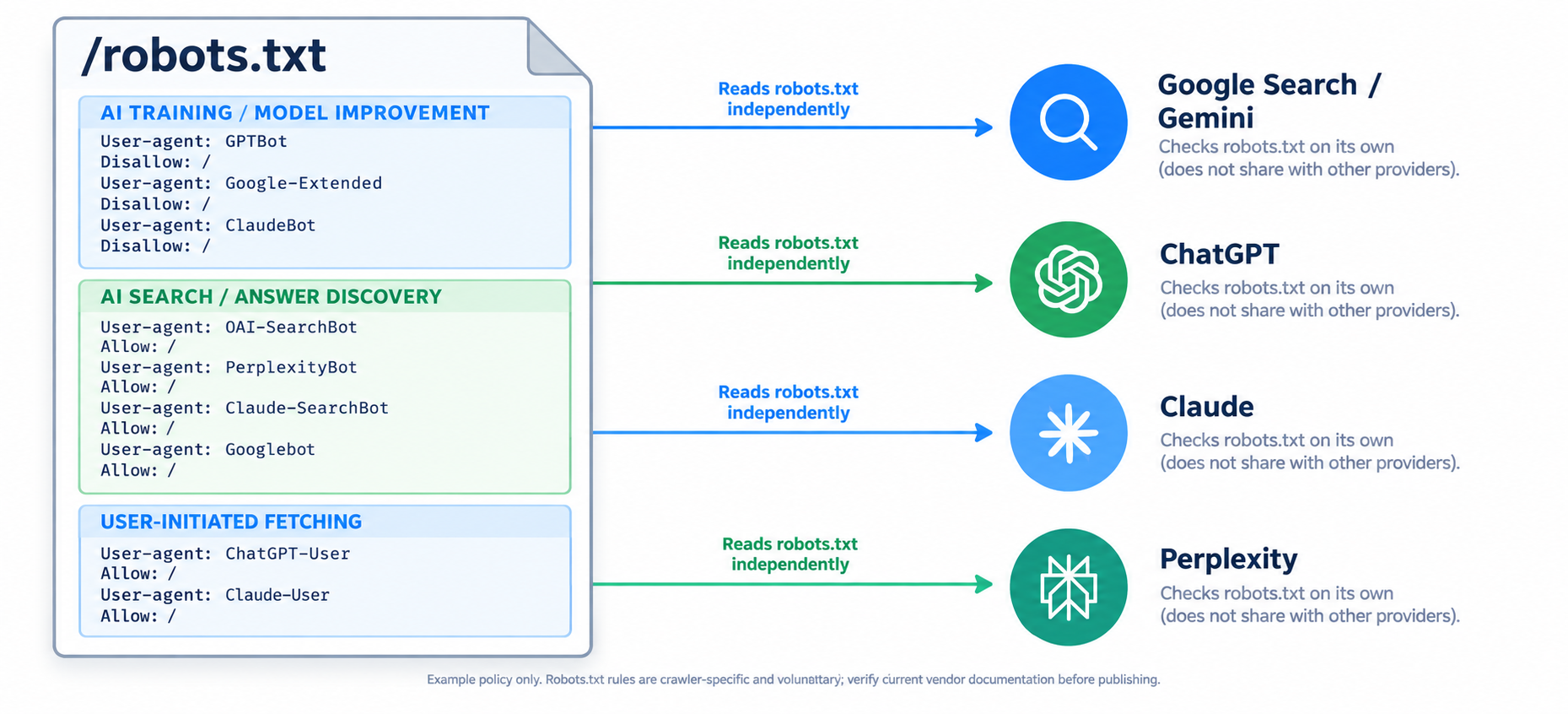
This one catches people. Each AI company publishes crawler names separate from Googlebot. As of October 2026:
- OpenAI says OAI-SearchBot is its search crawler, and that sites opted out of it “will not be shown in ChatGPT search answers.” GPTBot is a different crawler that collects content for model training. (OpenAI, “Overview of OpenAI Crawlers”, undated page, checked October 27, 2026.)
- Perplexity says PerplexityBot surfaces and links sites in its search results and recommends allowing it in robots.txt. It also tells firewall admins to allowlist its published IP ranges. (Perplexity, “Perplexity Crawlers”, undated page, checked October 27, 2026.)
- Google says its Google-Extended control covers AI training and grounding in other Google products, and that it “does not impact a site’s inclusion in Google Search.” (Google, common crawlers list, last updated October 15, 2026.)
So you can opt out of AI training and still appear in AI search answers, because those are different crawlers. Block everything with “AI” in the name and you cut yourself out of search answers by accident. A minimal robots.txt section that keeps the search crawlers in:
User-agent: OAI-SearchBot

Allow: /

User-agent: PerplexityBot

Allow: /
Then check the layer above robots.txt. Firewalls and CDNs can block a bot before it reads that file. In a July 1, 2025 post, Cloudflare announced it was changing its default to block AI crawlers. If your site runs through Cloudflare or a security plugin, look at the bot settings yourself, and make sure that login belongs to the business. Own the keys, or you’ll be asking a former vendor to let ChatGPT in.
How to measure AI visibility
No dashboard gives you a clean AI ranking yet. Use three imperfect signals together, and trust the direction more than any single number.
A fixed prompt list, checked monthly
Write 15 to 25 questions your buyers ask before they hire someone like you, broad (“best commercial electrician in Fort Worth”) and specific (“how long does a panel upgrade take”). Once a month, run the same list through ChatGPT, Perplexity, Gemini and Google AI Mode. Log each answer as named and linked, named only, or missing, and note who got named instead.
Example only: 20 prompts in four tools is 80 answers. Going from 6 mentions to 14 in a quarter is a trend. Answers vary between runs, so watch direction. If ChatGPT is the tool your buyers use most, my guide to getting found on ChatGPT has a ready-made worksheet and the four ways to run each prompt there.
AI referral traffic in GA4
In GA4, open Reports, Acquisition, Traffic acquisition, and set the dimension to Session source / medium. Filter for chatgpt.com, perplexity.ai, gemini.google.com and copilot.microsoft.com, and save the report. Treat the number as a floor. For Google’s own AI features, use Search Console. Google’s AI optimization guide (last updated July 10, 2026) says to use the Generative AI performance report to see how your content performs in generative AI features on Search and Discover. That traffic is also counted in your overall Web search totals.
The signals that don’t get credit
Plenty of AI influence never becomes a click. The buyer reads your name in an answer, then searches it or calls a week later. Track branded search in Search Console and ask every new lead where they heard about you. My own ads once showed zero conversions for years while driving leads, which is why I say don’t trust the zero.
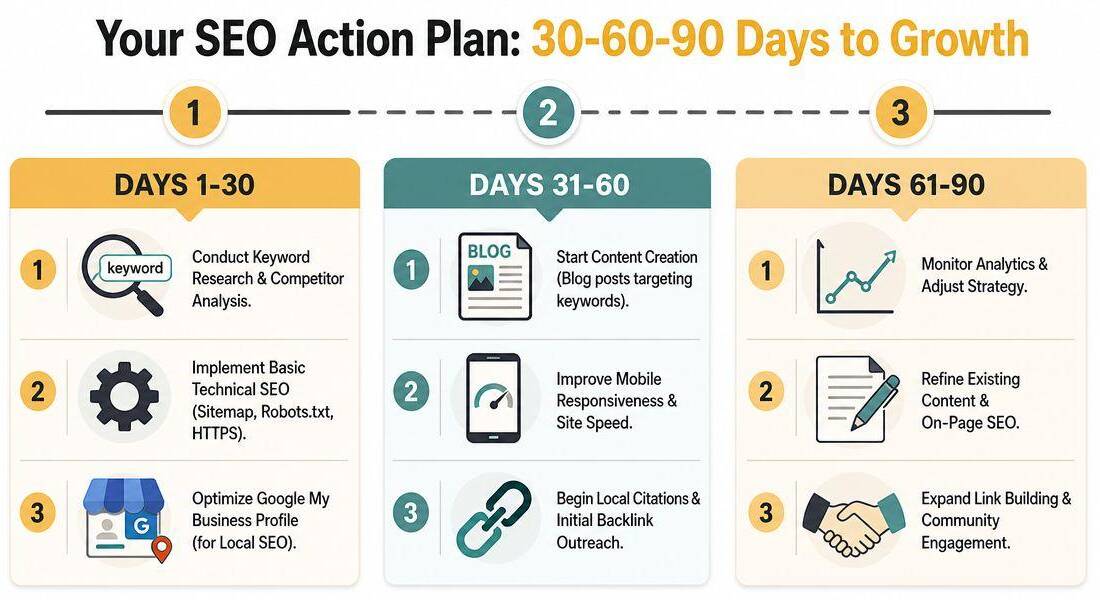
A 90-day AI SEO plan
Spend a little to learn before you spend a lot. And give the plan one owner: someone who sets the budget, reads the monthly check and decides what gets cut. In a small company that’s usually the owner or a part-time CMO, rarely the vendor doing the work.
Days 1 to 30: get eligible and get a baseline
- Write your prompt list and run the first check. This is your baseline.
- Review robots.txt, firewall and CDN bot settings. Allow the search crawlers you want.
- Confirm your important pages are indexed in Search Console.
- Set up the GA4 AI referral report and confirm the business owns every login involved.
Days 31 to 60: fix the facts and the openings
- Build one master fact sheet and correct every profile and directory to match it.
- Run the 150-word test on your top five to ten pages and rewrite the openings.
- Date your proof: case results, counts, reviews, pricing pages.
Days 61 to 90: earn corroboration and recheck
- Find where the businesses named instead of you get mentioned, and pitch two or three of those sources.
- Ask recent customers for reviews that name the specific service.
- Rerun the prompt list and compare against day one. Decide what to keep funding.
After day 90, keep the monthly check going. AI answers shift, and consistent presence beats one clever push.
When this is the wrong move
If your site isn't indexed or has no clear service pages, start with classic SEO. If nobody answers the phone within the hour, more visibility sends more buyers to a dead end, so fix follow-up first. Visibility is one part of a small business marketing system, and it only pays when the parts after it work. And if your buyers don't research online, say a niche product sold through a few distributors, AI visibility may not move revenue at all. Not sure which of these describes you? A marketing audit ranks AI search against your other leaks before you put money behind it.
The approach has a cost too. Plain answers up top give some information away, and some buyers will get what they need without visiting. You're trading clicks for being the name in the answer. For most service businesses that's worth it, because the goal was a booked job, not a click. Make the trade on purpose.
Be wary of anyone promising guaranteed AI placement. Google says indexing and serving aren't guaranteed, and the other tools don't publish ranking rules.
Check your own blind spots first
Want a second set of eyes on your pages before you rewrite anything? The Blind Spot Brain loads my marketing laws into ChatGPT, Claude or Gemini so you can ask it to review your own site, ads and numbers, including whether your openings pass the 150-word test. Every law is explained on the marketing laws hub.
Frequently asked questions
Find out what AI says about you before you spend more
The $47 AI audit checks what the major AI assistants say about your business, which competitors they name instead, and whether your site is ready to be cited. You keep the ranked fix list either way. To have the program run for you, the AI-Driven Growth System includes AI search optimization and business citations.
Or book a free 2-hour strategy session and we'll find what's keeping you out of AI answers. Rather talk now? Call 214.466.8332.

Los Angeles Build Expo 2026
📅 November 4–5, 2026
📍 Los Angeles Convention Center - South Hall G · Los Angeles, CA
Reserve My Seat View ConferenceFree · In-person · Limited seats