
They Searched for Roaches. Your Ad Showed Squirrels. You Paid Anyway.

Share:
Share:
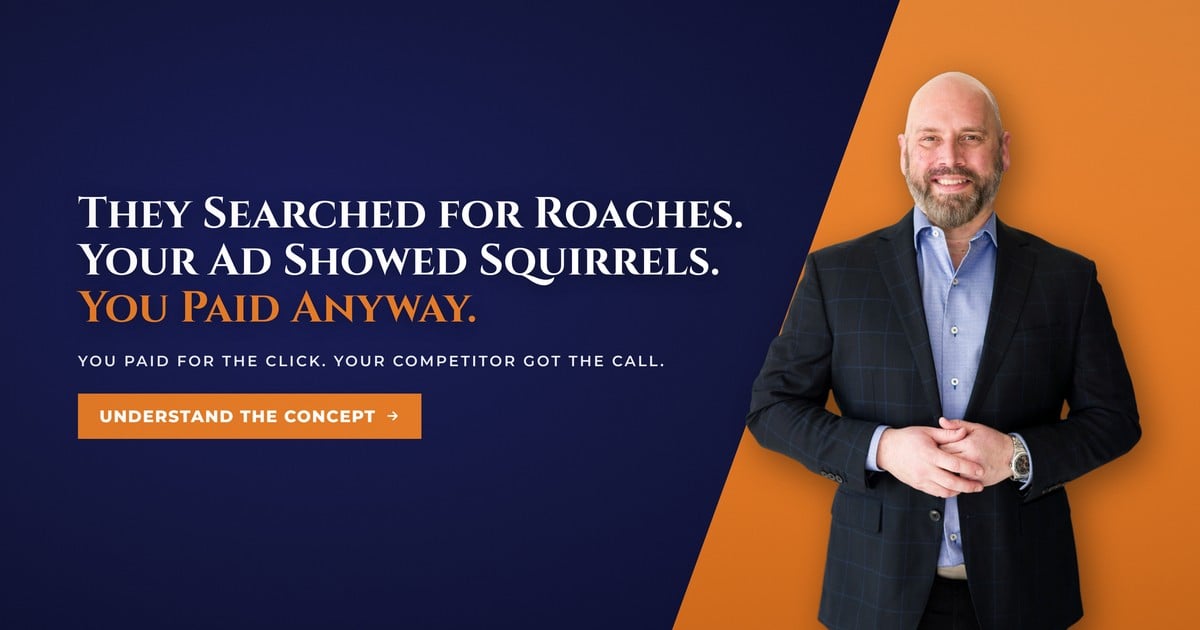
If someone searches a specific problem and your ad and your page show them something else, they leave. You still pay for the click. The fix is to show them the exact problem they typed, and the person who solves it, before you show them anything else.
What happens when your ad doesn’t match the search?
I say this to my team all the time. If I search “roaches in my kitchen pest control,” I want to see roaches in the kitchen. I want images of roaches in the kitchen. I want someone who solves that problem. I do not want squirrels and rats in my attic.
That sounds obvious. Go look at your ads anyway.
A lot of ad accounts send every click to the same place. The home page. Or one services page with everything on it. The person typed one problem and landed on a list of ten. Now they have to hunt for the thing they came for. Most people won’t hunt. They hit the back button and click the next company on the list.
The click cost you the same whether they called or left. You paid for it. Your competitor got the call.
Why do so many businesses get this wrong?
Because you are proud of everything you do. I get it. You built the company. You do roaches, termites, rodents, wildlife and mosquitoes, and you want people to know all of it.
The person with roaches in the kitchen does not care about all of it. Not today. Today there is a roach on the counter.
You might be thinking, but we do all of that. I believe you. Say it second.
The other reason is that one ad and one page is less work. It is easier to build and easier to manage. Easier to manage is not the same as better for you.
Does Google care if the ad and the page match?
Yes. Google grades it. It looks at how well your ad fits the search and how well your page fits the ad.
So you have two graders, Google and the buyer, and they are asking the same question. Did I get what I searched for?
What does it look like when it matches?
The search, the ad and the page all say the same thing. Roaches in the kitchen in the search. Roaches in the kitchen in the ad. Roaches in the kitchen on the page, with a picture of it and a person who fixes it.
The picture matters. I said images of roaches in the kitchen and I meant it. A photo of a smiling technician next to a van does not tell me you fix my problem.
I gave this direction this week for a mobile service business in DFW. They sell several different services, and people search for each one by name. So each service gets its own ad and its own page. Someone searching for one service should never land on a page about another one.
It works the same way outside of pest control. Hail damage is not a new roof. A broken tooth is not teeth whitening.
How do you check your own ads?
Pick your most important service. Search it the way a customer would, problem and all. Read your ad. Then open the page that ad sends people to.
If the first thing you see is not the problem you typed, you found the leak.
When do you tell them about everything else you do?
After they have bought the fix. Not before.
Solve the roaches. Do a good job. Now they trust you. Now you can tell them about termites and the attic, and they will listen, because you earned it.
Lead with all ten services and you sound like everybody else. Lead with the one they searched and you sound like the answer.
What’s the downside?
There is one and I am not going to hide it. This is more work. More ads to write. More pages to build. More to keep up with every month.
If your budget is small you can’t do every service at once, and you shouldn’t try. Start with the one service that matters most to your business. Get that one matching from the search to the ad to the page. See what it does. Then do the next one.
And somebody has to build it. Knowing this and doing it are two different things.
Understand more
I call this Roaches in My Kitchen. With my team it is no argument, no backlash, period. Every search gets its own matching ad and its own matching page.
It sits next to a few other things I teach.
The Girlfriend Effect says relevance comes before identity. A buyer does not care who you are until you give them a reason to. The roach on the page is the reason. Your name comes after.
It is the same with headlines and pictures. If your headline says “don’t dig up your floors,” the image can’t be a pipe. That is a total disconnect, and it kills the ad no matter how good each piece is on its own.
It also ties to showing up. You have to be seen first. Then being seen has to turn into a click. Then the click has to turn into a call. A page that doesn’t match the search breaks that last step, after you already paid for the first two.
You can read the rest in my marketing laws. If you want your own AI to check your ads and pages against them, the Blind Spot Brain is free.
Joshua Ramsey is a Fractional CMO and the founder of JRCMO (2018) and Strategic Point Marketing (2009). He has 25+ years in marketing, $1.5B+ in ad placements, 100,000+ campaigns and 300+ marketing plans behind him. He is a keynote speaker and the host of the Marketing Nightmares podcast. Book time with Josh at ramseyjosh.com.

Phoenix Build Expo 2026
📅 December 9–10, 2026
📍 Phoenix Convention Center - F & G · Phoenix, AZ
Reserve My Seat View ConferenceFree · In-person · Limited seats