

Fractional CMO ROI: What Real Results Look Like and How to Measure Them

Share:
Share:

Fractional CMO ROI is the extra gross profit the engagement caused, plus the wasted spend it stopped, minus the fee, divided by the fee. To measure it you need a baseline from before day one and one revenue-tied number you agreed on in writing. Without both, any ROI figure is a guess.
Expect the results in a certain order. The first 90 days usually bring truthful tracking, accounts the business owns and cuts to spend that wasn’t working. Lead volume and revenue tend to move later, often in months four to six. If someone promises a revenue jump in month one, ask what they plan to break to get it.
If you’re still working out what the role involves, start with the full guide to fractional CMOs.
Key takeaways
- ROI has two meanings: the return you can count afterward, and the result that wouldn’t have happened without the investment. Measure both.
- Truthful tracking, owned accounts and cut waste come first. Leads and revenue come later.
- Write down a baseline and one revenue-tied KPI before the engagement starts.
- Judge growth on incremental numbers, not blended averages, and compare against the same months last year.
- Real leadership results are things you can check yourself. Vanity results need someone to explain them to you.
In this guide
Two meanings of ROI, applied to a fractional CMO
Most people hear ROI and think of a ratio: money back divided by money spent. That’s return on investment, and it looks backward. It tells you whether something paid off once the books close.
There’s a second meaning I care about more. Result of investment asks what changed because you spent the money that wouldn’t have changed otherwise. I wrote this up as a law, the two meanings of ROI, because owners mix them up constantly.
For a fractional CMO the difference matters because the fee shows up on day one and the return shows up months later, tangled with seasonality, price changes and whatever your sales team did that quarter. Judge only the backward ratio and you’ll be judging noise for months.
The forward question gives you something to judge sooner. Do you now know which channels produce customers? Did the agency stop billing for campaigns that were never going to work? Can you fire a vendor tomorrow without losing your data? Those are results. Some of them never show up as a dollar figure, and you’d still pay for them.
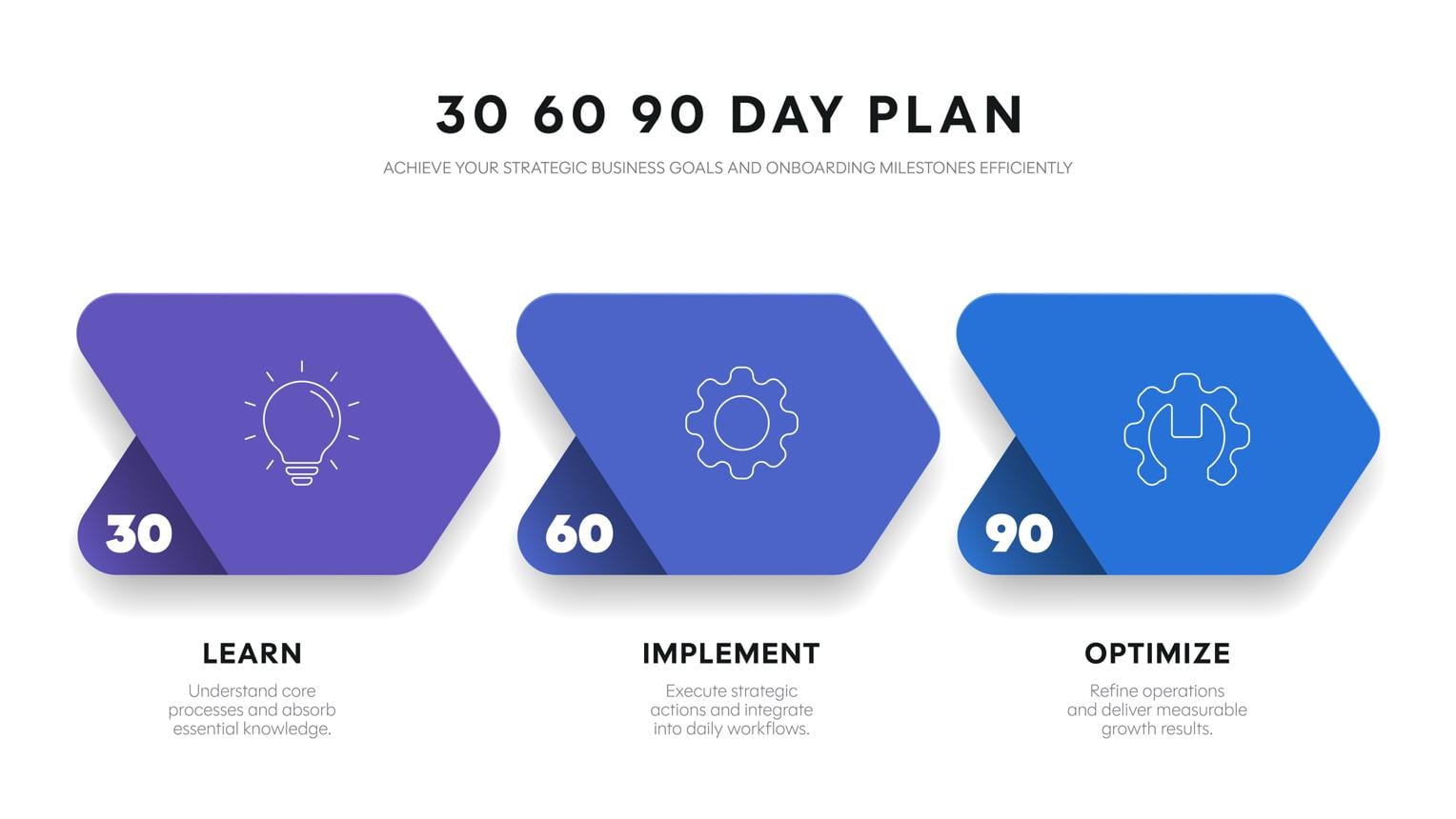
What to expect at 30, 90 and 180 days
Treat this as a rough shape, not a promise. A long B2B sales cycle stretches every stage; a local service business compresses them.
The first 30 days: the truth
The first month is diagnosis: a written baseline, an audit of what your ad platforms count as a conversion, and a list of who owns which login. It’s often the most uncomfortable month, because the numbers get worse on paper. Once page views and “engaged sessions” stop counting as conversions, reported results drop while real leads stay the same. That’s covered in the law on clarity of conversions: a real lead is always a whole number.
Days 31 to 90: ownership and cuts
By the end of the third month you should own every account under one business login (own the keys), have tracking you trust, and see spend cut from campaigns that weren’t producing customers. Cut waste is the first result that shows up as money, and often the first one that covers part of the fee. One caution: a channel reporting zero conversions isn’t automatically waste. Turn it off as a test and watch total leads, because the zero can lie.
Days 91 to 180: leads and revenue
This is when changes to message, audience and offer start showing up in lead volume and close rates. Changes made one at a time against a baseline let you say which one worked, and the order to make them in is laid out in how to improve marketing ROI. Revenue follows leads, so if your average sale takes three months to close, add three months to everything here.

How to measure fractional CMO ROI
You don’t need a dashboard with forty charts. You need a baseline, one KPI, the right kind of math and a written record of what changed, most of it set up before the engagement starts.
Write down the baseline before day one
Pull the last 12 months of the numbers that matter: real leads from your CRM (not the ad platforms), new customers, revenue, gross margin and total marketing spend by channel. Save it somewhere both of you can see it. If the tracking is too broken to give you a baseline, that’s your first finding, and it means the first months will go to fixing it.
Agree on one revenue-tied KPI
Picture yourself signing the monthly check. What number does your mind land on? If it lands on something you care about, like new customers or booked revenue, you’ll sign without friction. If it lands on nothing, the engagement is in trouble no matter how good the work is. That’s the Check-Writing Test. Put the KPI in writing. Open every meeting by confirming it’s still the number that matters, close by agreeing on it again, and report against it next time.
Measure incremental, not blended
Blended numbers are averages, and averages hide waste. Incremental numbers tell you what the last dollar bought.
Example only: you raise ad spend from $8,000 to $11,000 a month and new customers go from 40 to 44. Blended cost per customer moves from $200 to $250, which sounds fine. But the extra $3,000 bought four customers, so each one cost $750. If a customer is worth $600 in gross profit to you, that last $3,000 lost money while the average looked healthy. The law of diminishing returns explains why this happens to every channel eventually.
Do the same with time. Compare this year’s months against the same months last year, not against last month, or you’ll credit the CMO for summer.
Use a simple formula
Fractional CMO ROI = (incremental gross profit + wasted spend removed – fee) / fee.
Use gross profit, not revenue. A customer who pays you $2,000 on a job that costs $1,300 to deliver is worth $700 to this formula.
Example only (made-up numbers, not a quote): a business averaged 30 new customers a month in the baseline period. Six months in, it’s averaging 37. But the same months last year grew from 30 to 32 on their own, so call the true lift five customers a month. At $1,100 gross profit each, that’s $5,500. The engagement also cut $2,500 a month of ad spend that produced nothing. Against a $5,700 monthly fee: ($5,500 + $2,500 – $5,700) / $5,700 = 40%. Not dramatic, but positive, and the waste cut keeps paying after the engagement ends.
Count the results that never show up in the formula
Some useful outcomes have no dollar value attached. A campaign with zero leads can still be a result: if the clicks came and the form fills didn’t, it proved your website is the failure point, so you know where the next dollar goes. Owning your accounts is a result. So is knowing which channel your best customers came from. Write these down as they happen, or nobody will remember them at renewal time.
What real marketing leadership results look like
Here’s the test I use: could you check the result yourself, without the person who produced it in the room? If yes, it’s real. If you need a slide deck and someone to walk you through it, be suspicious.
| Area | Vanity outcome | Real result | How you check it |
|---|---|---|---|
| Tracking | “Conversions up 40%” | Platform conversions match real leads in the CRM | Count CRM leads for one month and compare |
| Spend | “Optimized campaigns” | A named list of campaigns cut, with the monthly savings | Look at the invoices before and after |
| Accounts | “We manage everything for you” | Every login owned by one business account | Try logging in to each one yourself |
| Reach | “5 million impressions” | More new customers than the same months last year | Compare customer counts year over year |
| Website | “New modern design” | A higher share of visitors becoming real leads | Leads divided by visitors, before and after |
| Agencies | “Great relationship with the agency” | The agency reports against your KPI every month | Read the last three agency reports |
| Strategy | A 60-page plan | One change tested at a time, with the result written down | Ask what was tested last month and what it did |
None of the real results require trust. They require access. ROI is one part of the picture; for the rest of the scorecard, see how to measure CMO performance.
What this looked like at Bear Iron Works
Bear Iron Works makes construction attachments: rock screens, bedding boxes and washout tubs. When the engagement started, the company had no SEO foundation, inconsistent Google Ads with no attribution, no CRM and no way to track where sales came from. Online sales were effectively zero, and revenue relied almost entirely on word of mouth.
The work ran in four streams. On search, it started with a full SEO diagnostic and a 30-60-90 day rebuild plan, rebuilt the product pages to be more content-rich, and moved the brand from bearironworks.net to beariron.com. On paid media, it launched four Google Ads campaigns, built Shopify tracking with GA4 event attribution so ad spend could be tied to revenue for the first time, and set up a retargeting framework running at $200 to $300 a month. On sales, it added a lead classification system inside the CRM and a call script for following up with website visitors. Last, it built a transition plan to hand strategy to the internal team.
According to the case study, over a period of under 12 months domain authority went from 10 to 18 (in under six months), referring domains went from 81 to nearly 200, backlinks tripled to 650+, and the company recorded its first confirmed sale from a ChatGPT referral.
The page reports tracking, authority and a first AI-referred sale, not a revenue total. That fits the order above: first get tracking that tells the truth, then grow on top of it. Judge this engagement only by a revenue ratio in month three and you'd miss most of what it built. The transition plan counts too, because it was built so the internal team could run the strategy afterward.
Two other pages show different sides of the same idea. Case study 143 covers a Kansas pest-control company whose biggest weakness was overspending on marketing. The maximize effectiveness case study shows how matching the right message to a campaign changes what the same ad spend produces.
When a fractional CMO won't pay off
The upside of a fractional CMO is senior judgment, applied to your real numbers, at a fraction of what a full-time CMO costs. The downside is that judgment alone doesn't execute anything. Here's when the ROI math usually won't work. Whether it's the right moment is a separate question, covered in when to hire a fractional CMO.
You need someone to do the tasks
If what's missing is someone to post, build pages and run campaigns, a CMO will write a plan that sits in a drawer. Hire the doer first.
The problem isn't marketing
If the product disappoints, the phones go unanswered or you can't fulfill the work you already have, more leads make things worse. You'll see it in the numbers: leads arrive, and they don't close or don't come back. Any CMO worth the fee should tell you that in the first month instead of spending the budget anyway.
The budget is too small to test anything
Measuring ROI takes enough volume to see a difference. Divide the monthly fee by the gross profit from one customer. If the answer is one or two customers a month, the math can work. If it's dozens, the math is against you before anyone starts.
You need revenue in 30 days
The first results are truth and cuts. If the business can't survive until month four or five, a cash-flow fix is the priority, not a marketing overhaul. If you want a fast first step, a money leak audit finds wasted spend without a retainer.
Check your own blind spots first
Before you hire anyone, find out what your own numbers say. The Blind Spot Brain loads my marketing laws into ChatGPT, Claude or Gemini so you can check your own ads, website and reports. You'll know your baseline, and which numbers are inflated, before the first meeting. Every law is explained on the marketing laws hub.
Frequently asked questions
Is a fractional CMO worth it?
It is worth it when the extra gross profit and cut waste it causes are larger than the fee, and when you have the budget and team to carry out the plan. It is not worth it if you need someone to do tasks, or if you expect revenue to jump in the first month.
How do you measure the ROI of a fractional CMO?
Record a baseline before day one, agree on one revenue-tied KPI in writing, and compare results against the same months last year. ROI equals the incremental gross profit plus wasted spend removed, minus the fee, divided by the fee.
How long does it take a fractional CMO to show results?
Expect honest tracking, owned accounts and cut waste in the first 30 to 90 days. Movement in lead volume and revenue usually takes longer, often four to six months, and longer still if your sales cycle runs many months.
What should a fractional CMO deliver in the first 90 days?
A written baseline, tracking you can trust, every account owned by the business, a list of spend that was cut and why, one agreed KPI, and a plan that names which single change gets tested first.
Should I hire a fractional CMO?
Hire one if you spend real money on marketing, cannot tie it to revenue, and have people or vendors who can execute a plan. Skip it if your problem is the product, fulfillment capacity, or a budget too small to test anything.
How much does a fractional CMO cost?
Most charge a monthly retainer based on hours and scope. JRcmo pricing depends on scope, so ask about it during the free 2-hour strategy session. Judge any fee by how many extra customers it takes to cover it.
Why did my marketing numbers drop after hiring a fractional CMO?
Often because the tracking got honest. When fake conversions like page views and engaged sessions stop being counted, reported conversions fall even though real leads have not changed. Compare real leads in the CRM before and after.
Find out what your marketing is producing now
If you want a baseline before you decide anything, book a free 2-hour strategy session. We'll go through your real numbers, find where the money is leaking, and work out whether a fractional CMO would pay for itself in your business. If it wouldn't, I'll say so. Prefer the phone? Call 214.466.8332.

Phoenix Build Expo 2026
📅 December 9–10, 2026
📍 Phoenix Convention Center - F & G · Phoenix, AZ
Reserve My Seat View ConferenceFree · In-person · Limited seats

